
Men's Health For Firefighters
FIREPROOF Wellness delivers men's health for firefighters, built for the demands of the job. Advanced labs, proven protocols, and a clinical team that has helped men more than double their testosterone levels without TRT. We help give you a clear picture of your health and build a plan around the realities of the fire service.
Male Firefighter Testosterone
Research following new firefighters through their first year on the job found that testosterone levels dropped by 37 percent within twelve months of entering the fire service. Not over a career. Within the first year. The occupational stress load, shift disruption, sleep fragmentation, and chronic physiological demand of the job begin suppressing testosterone almost immediately.
By the time a firefighter is mid-career, the cumulative picture is often significant. A study of 341 active US career firefighters found that more than one in three had low or borderline-low testosterone levels. The same study found that firefighters with borderline-low testosterone, levels that most standard lab reports would not even flag as a problem, had roughly four times the odds of reduced left ventricular wall thickness compared to firefighters with normal levels. That is not a good thing. And it was showing up in men whose numbers were not technically low enough to trigger any intervention.
This is what happens when the wrong questions get asked and the wrong thresholds get used.
This is what shows up in the body. Fatigue even after days off shift. Weight that will not move. Recovery that takes longer than it used to. Mood that leaves your family wondering what version of you they get today. Symptoms most firefighters write off as aging, when the data shows they are the documented response to the career itself.
TRT is not the only answer.
Testosterone Replacement Therapy is genuinely life-changing for firefighters who need it, and when it is monitored properly by a clinician who knows what they are doing, it can be the right call. The issue is not TRT itself. The issue is the trend.
Firefighters are jumping on TRT younger and younger, often without any clinical workup that identifies why their testosterone is low in the first place. That matters because TRT comes with real trade-offs. Natural production gets suppressed. Fertility takes a hit. The body becomes dependent on an external driver, and that dependency is often permanent. For a 30-year-old firefighter who has a desire to grow their family, or who simply wants to know whether his body can recover on its own first, those trade-offs are worth understanding before he starts.
There is a different path that should be explored first. FIREPROOF's Testosterone Optimization Protocol works by identifying and addressing the root causes behind the decline. Hormonal imbalances. Metabolic disruption. Nutrient deficiencies. Sleep dysfunction specific to shift workers. When those root causes get addressed, the body does what it was built to do.
Firefighters who decided to work with FIREPROOF had average total testosterone go from 358 to 809 in 4 months. No TRT and no injections
These numbers are not outliers. They are the documented average across the firefighters we have worked with.
For some firefighters, TRT will still be the right answer after the workup is done. That is a legitimate clinical decision and we support it when it is appropriate. The point is that the decision should be made with the full picture in front of you, not because TRT was the first and only option anyone offered.
The Results Speak For Themselves
We asked our clients what their biggest wins were from working with FIREPROOF Wellness. Here’s what they said:
-
“It's been a full turn around... I feel 10 years younger.”
-
“You've helped me do a 180, and I feel like a totally different person than I was a year ago.”
-
“My testosterone initially was around 400, and my last labs was 950. I've over doubled!”
-
“I was able to workout and maintain [fitness], lose a bunch of weight, and I gained a whole bunch of muscle.”
-
“I feel more confident now to do the job and not hurt myself, and be able to be an effective part of the team.”
-
“My labs showed I was deficient in a few areas but it has all leveled out and I'm where I need to be and should be.”
-
“My mental health, my family life is better. I'm not angry, I'm not tired. I'm doing better at work.”
-
“I have taken huge leaps... this was a very individualized plan, and I've never had that anywhere else.”
-
“My A1c was prediabetic for the last six years, and those numbers have gone way down.”
These results come from participants in busy, metropolitan fire departments, and they can be your story too.
What We Offer
Tier 1
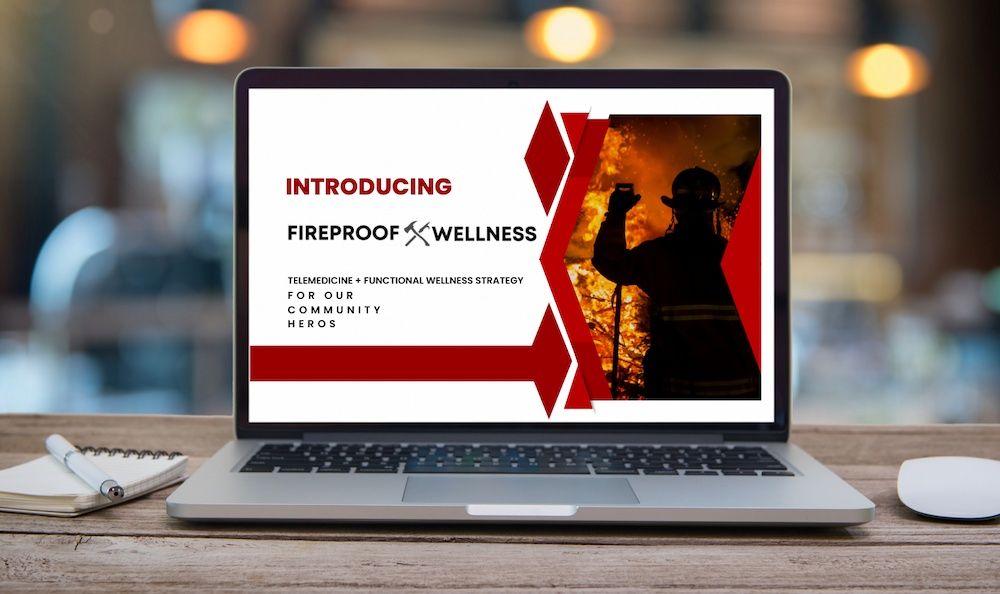
The FIREPROOF Method Course — $279 Lifetime Access
A self-paced, research-backed education platform built specifically for the firefighter lifestyle. Every module is taught with a direct understanding of shift schedules, physical demands, and the real-world limitations of this career. This is not generic wellness content repackaged with a fire truck on the cover. Every strategy, every recommendation, and every lesson was built around the specific health risks firefighters face and the specific constraints they operate within.
Get StartedModule Topics
Hormones
Why your testosterone is dropping and what actually reverses it.
What is happening to your testosterone and why. How shift work, toxic exposures, sleep disruption, and occupational stress drive hormonal decline, what the research says about the timeline, and what you can do to slow and reverse it without pharmaceutical intervention
Nutrition
Eating for a fire service career, not a desk job.
Eating for a fire service career is not the same as eating for the general population. This module covers nutrition strategies built around shift patterns, station cooking, limited prep time, and the metabolic demands of a job that alternates between sedentary and high-intensity without warning.
On-Shift Recovery
Reduce the damage in real time.
Most of the damage happens during the shift itself. This module covers the strategies that reduce that damage in real time, including what to do during long calls, extended operations, and the physiological recovery window immediately following a fire, plus what determines whether that damage adds up over a career.
Off-Shift Recovery
The hours between shifts.
What you do between shifts determines how much damage accumulates over a career. Sleep architecture for shift workers, circadian rhythm management, and the specific recovery protocols that separate firefighters who hold up over a 25-year career from those who don't.
Mental Health
The cost of silence is documented.
The fire service talks about mental health more now, but rarely ties it to physical health outcomes. This module covers the psychological toll of the career, tools for managing traumatic exposure, and how mental health connects to testosterone and heart disease risk.
Fitness
Train for a 30 year career.
What you do between shifts determines how much damage accumulates over a career. Sleep architecture for shift workers, circadian rhythm management, and the specific recovery protocols that separate firefighters who hold up over a 25-year career from those who don't.
Tier 2

The FIREPROOF Method + Telemedicine — $1,825 One time or 4 monthly payments of $456.25
Everything in the course, plus direct access to medical providers trained specifically in firefighter health. This is where the education becomes a clinical plan built around your actual body.
Most firefighters have had blood drawn at some point and been told everything looks normal. FIREPROOF goes deeper. We order over 90 targeted biomarkers chosen specifically for the risks firefighters face, including testosterone, advanced lipid profiles, inflammatory markers, cortisol, thyroid function, metabolic markers, and more. What makes those labs meaningful is what happens next.
Your provider dives deep with the data, connect the patterns, and build a personalized clinical plan based on what your body is actually showing. Every result is explained in plain language. Every recommendation is grounded in where your numbers are today and where they need to be. Every step forward is guided by a provider who understands the career you are working and the toll it takes.
For firefighters dealing with declining testosterone, that guidance follows our Testosterone Optimization Protocol, which has produced documented improvements of 200 to 400 percent in client testosterone levels without the use of Testosterone Replacement Therapy.
What is included:
-
The complete FIREPROOF Method course with all modules and lifetime access
-
5 telemedicine visits with licensed providers trained in firefighter health
-
Provider ordering of comprehensive lab panel covering over 90 targeted biomarkers- actual lab costs not included. Bill to your PPO plan or take advantage of our cash-pay discount
-
Personalized clinical plan built around your results and your career
-
Testosterone Optimization Protocol
-
Prescription care when clinically indicated
-
Supplement discounts through Fullscript
Payment plan available.
Get StartedTier 3

FIREPROOF Method VIP — $4,041 one time or 6 monthly payments of $673.50
Everything in the Telemedicine Package, plus the most comprehensive firefighter health evaluation available anywhere. For firefighters who want the full picture, this is it.
In addition to the course, the clinical visits, and the Testosterone Optimization Protocol, the VIP Package adds three specialty lab review appointments and three advanced panels (cost included) that go beyond standard biomarkers into the territory most providers never explore.
Payment plan available.
Get StartedPFAS Exposure Testing
A blood panel measuring levels of PFAS compounds linked to negative health outcomes in people with high occupational exposure. Results are compared against CDC averages and evaluated against risk thresholds set by the National Academies of Sciences, Engineering and Medicine. For firefighters who have worked with AFFF foam and contaminated gear, this is not theoretical. It is documented exposure, and now it can be measured.
Galleri Multi-Cancer Screen
A single blood draw that screens for signals associated with more than 50 types of cancer, including many with no other recommended screening test available. Pancreatic, ovarian, liver, esophageal. The cancers that are hardest to catch and most lethal when caught late. For firefighters, whose cancer incidence outpaces the general population across multiple sites, this is proactive clinical care at the highest level currently available.
NutrEval Panel
An advanced assessment of nutrient status, toxin burden, and mitochondrial function that goes well beyond a standard metabolic panel. This test identifies specific deficiencies, metabolic imbalances, and functional gaps that directly affect energy, recovery, hormonal health, and long-term resilience. It provides a level of clinical detail that changes the specificity of the plan your provider can build for you, tailored to the demands of firefighting.
Your health impacts your crew, your family, and your future.
Protect your health with the same dedication you bring to the fireground.
Get Started Today.



GET OUR FREE GUIDE
WHEN YOU SUBSCRIBE AND COMPLETE EMAIL CONFIRMATION